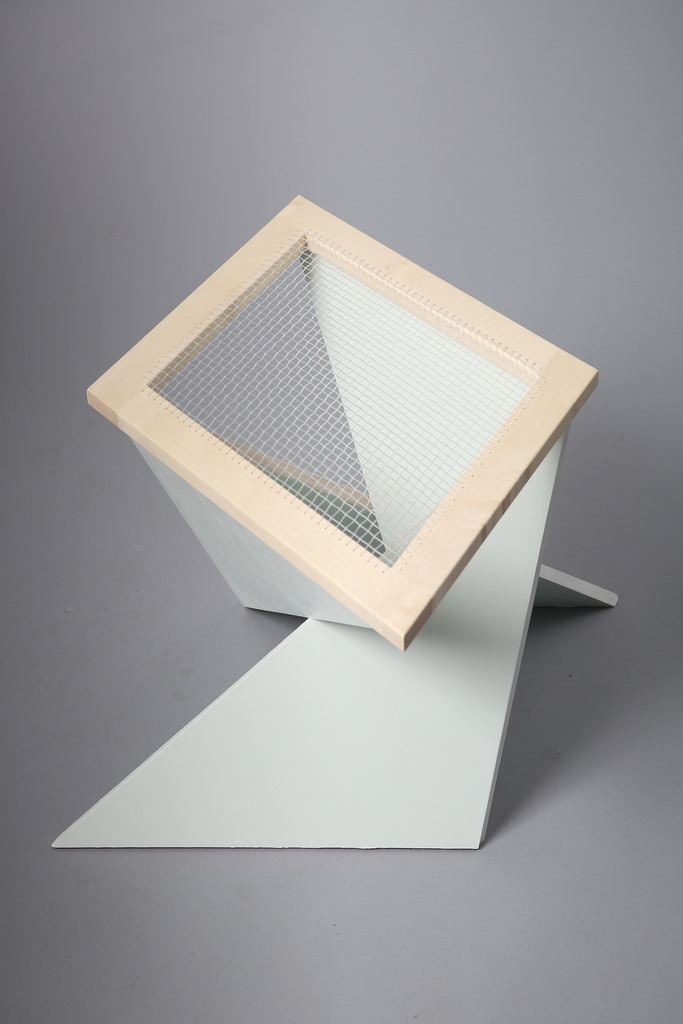
Ädda
You're a new moon
'Perhaps it hasn't one,' Alice ventured to remark.
'Tut, tut, child!' said the Duchess. 'Everything's got a moral, if only you can find it.' And she squeezed herself up closer to Alice's side as she spoke.
Alice did not much like keeping so close to her: first, because the Duchess was VERY ugly; and secondly, because she was exactly the right height to rest her chin upon Alice's shoulder, and it was an uncomfortably sharp chin. However, she did not like to be rude, so she bore it as well as she could.
'The game's going on rather better now,' she said, by way of keeping up the conversation a little.
''Tis so,' said the Duchess: 'and the moral of that is—"Oh, 'tis love, 'tis love, that makes the world go round!"'
'Somebody said,' Alice whispered, 'that it's done by everybody minding their own business!'
'Ah, well! It means much the same thing,' said the Duchess, digging her sharp little chin into Alice's shoulder as she added, 'and the moral of THAT is—"Take care of the sense, and the sounds will take care of themselves."'
'How fond she is of finding morals in things!' Alice thought to herself.
'I dare say you're wondering why I don't put my arm round your waist,' the Duchess said after a pause: 'the reason is, that I'm doubtful about the temper of your flamingo. Shall I try the experiment?'
'HE might bite,' Alice cautiously replied, not feeling at all anxious to have the experiment tried.
So she was considering in her own mind (as well as she could, for the hot day made her feel very sleepy and stupid), whether the pleasure of making a daisy-chain would be worth the trouble of getting up and picking the daisies, when suddenly a White Rabbit with pink eyes ran close by her.
There was nothing so VERY remarkable in that; nor did Alice think it so VERY much out of the way to hear the Rabbit say to itself, 'Oh dear! Oh dear! I shall be late!' (when she thought it over afterwards, it occurred to her that she ought to have wondered at this, but at the time it all seemed quite natural); but when the Rabbit actually TOOK A WATCH OUT OF ITS WAISTCOAT-POCKET, and looked at it, and then hurried on, Alice started to her feet, for it flashed across her mind that she had never before seen a rabbit with either a waistcoat-pocket, or a watch to take out of it, and burning with curiosity, she ran across the field after it, and fortunately was just in time to see it pop down a large rabbit-hole under the hedge.
In another moment down went Alice after it, never once considering how in the world she was to get out again.
The rabbit-hole went straight on like a tunnel for some way, and then dipped suddenly down, so suddenly that Alice had not a moment to think about stopping herself before she found herself falling down a very deep well.
Either the well was very deep, or she fell very slowly, for she had plenty of time as she went down to look about her and to wonder what was going to happen next. First, she tried to look down and make out what she was coming to, but it was too dark to see anything; then she looked at the sides of the well, and noticed that they were filled with cupboards and book-shelves; here and there she saw maps and pictures hung upon pegs. She took down a jar from one of the shelves as she passed; it was labelled 'ORANGE MARMALADE', but to her great disappointment it was empty: she did not like to drop the jar for fear of killing somebody, so managed to put it into one of the cupboards as she fell past it.
'Well!' thought Alice to herself, 'after such a fall as this, I shall think nothing of tumbling down stairs! How brave they'll all think me at home! Why, I wouldn't say anything about it, even if I fell off the top of the house!' (Which was very likely true.)
Down, down, down. Would the fall NEVER come to an end! 'I wonder how many miles I've fallen by this time?' she said aloud. 'I must be getting somewhere near the centre of the earth. Let me see: that would be four thousand miles down, I think—' (for, you see, Alice had learnt several things of this sort in her lessons in the schoolroom, and though this was not a VERY good opportunity for showing off her knowledge, as there was no one to listen to her, still it was good practice to say it over) '—yes, that's about the right distance—but then I wonder what Latitude or Longitude I've got to?' (Alice had no idea what Latitude was, or Longitude either, but thought they were nice grand words to say.)
Presently she began again. 'I wonder if I shall fall right THROUGH the earth! How funny it'll seem to come out among the people that walk with their heads downward! The Antipathies, I think—' (she was rather glad there WAS no one listening, this time, as it didn't sound at all the right word) '—but I shall have to ask them what the name of the country is, you know. Please, Ma'am, is this New Zealand or Australia?' (and she tried to curtsey as she spoke—fancy CURTSEYING as you're falling through the air! Do you think you could manage it?) 'And what an ignorant little girl she'll think me for asking! No, it'll never do to ask: perhaps I shall see it written up somewhere.'
Down, down, down. There was nothing else to do, so Alice soon began talking again. 'Dinah'll miss me very much to-night, I should think!' (Dinah was the cat.) 'I hope they'll remember her saucer of milk at tea-time. Dinah my dear! I wish you were down here with me! There are no mice in the air, I'm afraid, but you might catch a bat, and that's very like a mouse, you know. But do cats eat bats, I wonder?' And here Alice began to get rather sleepy, and went on saying to herself, in a dreamy sort of way, 'Do cats eat bats? Do cats eat bats?' and sometimes, 'Do bats eat cats?' for, you see, as she couldn't answer either question, it didn't much matter which way she put it. She felt that she was dozing off, and had just begun to dream that she was walking hand in hand with Dinah, and saying to her very earnestly, 'Now, Dinah, tell me the truth: did you ever eat a bat?' when suddenly, thump! thump! down she came upon a heap of sticks and dry leaves, and the fall was over.
This seemed to Alice a good opportunity for making her escape; so she set off at once, and ran till she was quite tired and out of breath, and till the puppy's bark sounded quite faint in the distance.
'And yet what a dear little puppy it was!' said Alice, as she leant against a buttercup to rest herself, and fanned herself with one of the leaves: 'I should have liked teaching it tricks very much, if—if I'd only been the right size to do it! Oh dear! I'd nearly forgotten that I've got to grow up again! Let me see—how IS it to be managed? I suppose I ought to eat or drink something or other; but the great question is, what?'
The great question certainly was, what? Alice looked all round her at the flowers and the blades of grass, but she did not see anything that looked like the right thing to eat or drink under the circumstances. There was a large mushroom growing near her, about the same height as herself; and when she had looked under it, and on both sides of it, and behind it, it occurred to her that she might as well look and see what was on the top of it.
She stretched herself up on tiptoe, and peeped over the edge of the mushroom, and her eyes immediately met those of a large caterpillar, that was sitting on the top with its arms folded, quietly smoking a long hookah, and taking not the smallest notice of her or of anything else.
The Caterpillar and Alice looked at each other for some time in silence: at last the Caterpillar took the hookah out of its mouth, and addressed her in a languid, sleepy voice.
'Who are YOU?' said the Caterpillar.
This was not an encouraging opening for a conversation. Alice replied, rather shyly, 'I—I hardly know, sir, just at present—at least I know who I WAS when I got up this morning, but I think I must have been changed several times since then.'
'What do you mean by that?' said the Caterpillar sternly. 'Explain yourself!'
'I can't explain MYSELF, I'm afraid, sir' said Alice, 'because I'm not myself, you see.'
'I don't see,' said the Caterpillar.
'Please would you tell me,' said Alice, a little timidly, for she was not quite sure whether it was good manners for her to speak first, 'why your cat grins like that?'
'It's a Cheshire cat,' said the Duchess, 'and that's why. Pig!'
She said the last word with such sudden violence that Alice quite jumped; but she saw in another moment that it was addressed to the baby, and not to her, so she took courage, and went on again:—
'I didn't know that Cheshire cats always grinned; in fact, I didn't know that cats COULD grin.'
'They all can,' said the Duchess; 'and most of 'em do.'
'I don't know of any that do,' Alice said very politely, feeling quite pleased to have got into a conversation.
'You don't know much,' said the Duchess; 'and that's a fact.'
Alice did not at all like the tone of this remark, and thought it would be as well to introduce some other subject of conversation. While she was trying to fix on one, the cook took the cauldron of soup off the fire, and at once set to work throwing everything within her reach at the Duchess and the baby—the fire-irons came first; then followed a shower of saucepans, plates, and dishes. The Duchess took no notice of them even when they hit her; and the baby was howling so much already, that it was quite impossible to say whether the blows hurt it or not.
'Oh, PLEASE mind what you're doing!' cried Alice, jumping up and down in an agony of terror. 'Oh, there goes his PRECIOUS nose'; as an unusually large saucepan flew close by it, and very nearly carried it off.
'If everybody minded their own business,' the Duchess said in a hoarse growl, 'the world would go round a deal faster than it does.'
'This here young lady,' said the Gryphon, 'she wants for to know your history, she do.'
'I'll tell it her,' said the Mock Turtle in a deep, hollow tone: 'sit down, both of you, and don't speak a word till I've finished.'
So they sat down, and nobody spoke for some minutes. Alice thought to herself, 'I don't see how he can EVEN finish, if he doesn't begin.' But she waited patiently.
'Once,' said the Mock Turtle at last, with a deep sigh, 'I was a real Turtle.'
These words were followed by a very long silence, broken only by an occasional exclamation of 'Hjckrrh!' from the Gryphon, and the constant heavy sobbing of the Mock Turtle. Alice was very nearly getting up and saying, 'Thank you, sir, for your interesting story,' but she could not help thinking there MUST be more to come, so she sat still and said nothing.
'When we were little,' the Mock Turtle went on at last, more calmly, though still sobbing a little now and then, 'we went to school in the sea. The master was an old Turtle—we used to call him Tortoise—'
'Why did you call him Tortoise, if he wasn't one?' Alice asked.
'We called him Tortoise because he taught us,' said the Mock Turtle angrily: 'really you are very dull!'
'You ought to be ashamed of yourself for asking such a simple question,' added the Gryphon; and then they both sat silent and looked at poor Alice, who felt ready to sink into the earth. At last the Gryphon said to the Mock Turtle, 'Drive on, old fellow! Don't be all day about it!' and he went on in these words:
'Yes, we went to school in the sea, though you mayn't believe it—'
'Change lobsters again!' yelled the Gryphon at the top of its voice.
'Back to land again, and that's all the first figure,' said the Mock Turtle, suddenly dropping his voice; and the two creatures, who had been jumping about like mad things all this time, sat down again very sadly and quietly, and looked at Alice.
'It must be a very pretty dance,' said Alice timidly.
'Would you like to see a little of it?' said the Mock Turtle.
'Very much indeed,' said Alice.
'Come, let's try the first figure!' said the Mock Turtle to the Gryphon. 'We can do without lobsters, you know. Which shall sing?'
'Oh, YOU sing,' said the Gryphon. 'I've forgotten the words.'
So they began solemnly dancing round and round Alice, every now and then treading on her toes when they passed too close, and waving their forepaws to mark the time, while the Mock Turtle sang this, very slowly and sadly:—
'"Will you walk a little faster?" said a whiting to a snail. "There's a porpoise close behind us, and he's treading on my tail. See how eagerly the lobsters and the turtles all advance! They are waiting on the shingle—will you come and join the dance? Will you, won't you, will you, won't you, will you join the dance? Will you, won't you, will you, won't you, won't you join the dance? "You can really have no notion how delightful it will be When they take us up and throw us, with the lobsters, out to sea!" But the snail replied "Too far, too far!" and gave a look askance— Said he thanked the whiting kindly, but he would not join the dance. Would not, could not, would not, could not, would not join the dance. Would not, could not, would not, could not, could not join the dance. '"What matters it how far we go?" his scaly friend replied. "There is another shore, you know, upon the other side. The further off from England the nearer is to France— Then turn not pale, beloved snail, but come and join the dance. Will you, won't you, will you, won't you, will you join the dance? Will you, won't you, will you, won't you, won't you join the dance?"'
'Thank you, it's a very interesting dance to watch,' said Alice, feeling very glad that it was over at last: 'and I do so like that curious song about the whiting!'
'As wet as ever,' said Alice in a melancholy tone: 'it doesn't seem to dry me at all.'
'In that case,' said the Dodo solemnly, rising to its feet, 'I move that the meeting adjourn, for the immediate adoption of more energetic remedies—'
'Speak English!' said the Eaglet. 'I don't know the meaning of half those long words, and, what's more, I don't believe you do either!' And the Eaglet bent down its head to hide a smile: some of the other birds tittered audibly.
'What I was going to say,' said the Dodo in an offended tone, 'was, that the best thing to get us dry would be a Caucus-race.'
'What IS a Caucus-race?' said Alice; not that she wanted much to know, but the Dodo had paused as if it thought that SOMEBODY ought to speak, and no one else seemed inclined to say anything.
'Why,' said the Dodo, 'the best way to explain it is to do it.' (And, as you might like to try the thing yourself, some winter day, I will tell you how the Dodo managed it.)
First it marked out a race-course, in a sort of circle, ('the exact shape doesn't matter,' it said,) and then all the party were placed along the course, here and there. There was no 'One, two, three, and away,' but they began running when they liked, and left off when they liked, so that it was not easy to know when the race was over. However, when they had been running half an hour or so, and were quite dry again, the Dodo suddenly called out 'The race is over!' and they all crowded round it, panting, and asking, 'But who has won?'
This question the Dodo could not answer without a great deal of thought, and it sat for a long time with one finger pressed upon its forehead (the position in which you usually see Shakespeare, in the pictures of him), while the rest waited in silence. At last the Dodo said, 'EVERYBODY has won, and all must have prizes.'
'But who is to give the prizes?' quite a chorus of voices asked.
'Why, SHE, of course,' said the Dodo, pointing to Alice with one finger; and the whole party at once crowded round her, calling out in a confused way, 'Prizes! Prizes!'